Tuesday, May 19, 2009

Pet Turtle Care : Easy to Find Exotic Types of Turtles

Pet Turtle Care

If you are going to get a turtle as your pet then you will probably visit a local pet store. The types of turtles that you will find in common pet stores around United States are native ones. This local native types of turtles are recommended for beginner turtle keepers. But, in time, if you have some experience with turtle care you can consider to buy some exotic types of turtles. The problem with exotic turtles is that if they aren't born in captivity then they will hardly adapt. but with proper care having an exotic turtle as your pet is not impossible.

One of the most common types of turtles in the United States pet stores is the Reeves Turtle. It's a small type of turtle that has some kind of rectangular shape. The carapace has a browny colour and the skin is green with yellow stripes. They are originary from Asia. they can be feed with different types of vegetables, worms, fish or turtle food. The turtle care guideline is similar to the sliders turtles.

Two other types of turtles would be Asian Yellow Pond Turtle (Mauremys mutica) and the Asian Leaf Turtle (Cyclemys dentata). They look much alike the Reeve's Turtle regarding size and shape. The coloration is predominated by yellow and brown. Keep in mind that are more therestrial turtles than the sliders and so they need a larger basking and land area. Following the turtle care advice for the Reeve's turtle you should have any problems in growing them.

The African Mud Turtle was recently imported in a large number. These types of turtles, although they are mud turtles, are very much alike the Painted turtles. They have brown carapace with yellow or gray skin. You can try to setups a slider enclousure for them and you shouldn't have any problems.

There are some other types of turtles that can be found in the pet stores but if you are really looking for a special type of exotic turtle than you should contact a reptile seller. There was a time when you could find Snake-neck turtles and Big-headed turtles on the pet stores market and maybe in time they will be imported in larger numbers again. This types of turtles have a really special look that you won't forget. The Snake-neck turtles have a very long neck, almost as long as their carapace. Big-headed Turtles, like their name says have a huge head that can't even retract in the shell.

So all in all there are some types of exotic turtles on the United States pet market but if you are a beginner in growing turtles then i advise you to take a native one in your home.

If you are looking for information on different common types of turtles, visit us at one of the best turtle care advice site.

Article Source: http://EzineArticles.com/?expert=Ispas_Marin

Pet Turtle Care : Buying And Care Tips When Considering Box Turtles As Exotic Pets

Pet Turtle Care

Keeping box turtles as exotic pets may be a good decision for many people, since they are easy to live with and easy to maintain. It is also very enjoyable to witness these creatures grow and live. Interested in having box turtles as exotic pets? Here are some tips that might be useful for you before buying ones.

First, avoid buying box turtles during cold seasons, because box turtles hibernate during such seasons. If you keep buying them anyway, your box turtles will probably get stressed out due to the dehydration and starvation that comes with the hibernation time.

When choosing box turtles, check for its strong reflexes by gently tugging its hind leg and seeing if it quickly and strongly pulls its legs away. A good box turtle would feel solid and weighty when you pick it up. The face and limbs should have no swellings, the eyes should be alert and clear. There should be no discolorations or slime on the shell.

Boxed turtles live well both indoors and outdoors. If you want to keep them indoor, an 36 by 12 inches aquarium is a good idea. And it would be better if you install an aquarium heater to maintain a 77-96 degree F temperature on the aquarium, since turtles tend to become sluggish and lose their appetite when the temperature is low. Box turtles prefer living on slightly moistened potting soil that have no coarse substrates that may damage their shells, so there should be enough water for the turtle to dip in and climb out as it wants. And don't forget to keep the aquarium clean.

Last but not least, don't forget to feed your box turtles once every morning for youngsters, and every other day for adults. Combining varied vegetables with canned dog food are recommended for your box turtles, but you can also feed them with chicken liver, earthworms, slugs and small insects. You may also provide food sources like fruits and green vegetables that are best for terrapins.

One thing that you should realize is that being an exotic pet owner requires a lot of responsibility. You should always assess yourself if you can really provide care for your exotic pets. You should plan very well so that you can prepare properly once you have decided to own exotic pets.

Or more information about Exotic Pets please visit http://www.YourExoticPets.com

There you can also find exotic pet health and care tips, exotic pet buying tips, and so much more!

Article Source: http://EzineArticles.com/?expert=Deeo_Nyssa

Pet Turtle Care : Proper Turtle Care

Pet Turtle Care

Like most amphibians and reptiles, turtles are an exotically, fascinating species that many folks raise as pets owing to their 'novelty factor' and the fact that they need little "love" and attention. If you have large furry animals as pets, the pertaining to their care in terms of immunization, shots, operation and expensive accessories like dog houses, toys and grooming products is an inevitable expenditure and costly. By contrast, turtle care isn't as time consuming, expensive, and complicated provided they too are looked after with utmost care in regards to their diet, habitat arrangements and treatment to ensure a healthy and long life.

To keep your pet turtles safe, secure, and comfortable, you have to undertake a few measures like providing ample of room space to survive in, appropriate lighting, clean water and a basking lamp. If you want to keep your pet turtle free from any disease or infection, three rules of the thumb must be regularly administered: proper temperature in the aquarium, good water quality and regulated feeding habits. Your turtle's aquarium must be filled 2/3rd with water for swimming purposes and the remainder 1/3rd should be spared for basking reasons that is inculcated by bringing in a full spectrum ultra-violet light source. To ensure longevity and reduce the infections your turtle can get, it is very important to keep the water in the aquarium very clean and devoid of any contaminants with may be an aquarium filtration system. Algae can easy grow on a turtles shell. A strict regime must be followed when it comes to thoroughly cleaning the interiors as well as the exteriors of the aquarium. The very minimum is once a month but twice a month is much better.

When feeding your turtle, carry it out in another small holding tank, away from its normal enclosure as uneaten food and leftovers will invite disease causing microorganisms. If you are concerned about your turtles hygiene, rinse it's shell with slightly warm water after each feed. Make sure he is only feed proper turtle food.

Turtle care is a job for responsible adults. If not cleaned often and taken care of diligently, turtles emit a foul smell that can get unbearable. Avoid using tap water to fill your turtle's tank because tap water generally harbors chemicals like fluoride and chlorine which can cause the pH balance to go haywire. For swimming purposes, dechlorinated water must be utilized and filtered water for drinking.

Turtles are certainly interesting pets to raise, simply watch and interact with. They bring along a lot of selfless excitement and enjoyment for you and your family and in return expect a stable home and loads of love. However, it is important to care for them properly otherwise they will get sick and die. Without proper care, turtle shells will get bacterial infections. Be sure to take care of all the needs of your turtles.

Matt is the owner of many pet turtles and has been taking care of them for many years now. You can read more about turtle care and turtle tanks at his website on taking care of turtles.

Article Source: http://EzineArticles.com/?expert=Matthew_Kepnes

Pet Turtle Care : Owning pet turtle

Pet Turtle Care

Turtles are one of the most popular, exotic and fascinating creatures available in a pet store. If you are thinking of adopting a pet turtle, your main prerogative must be to be well informed and aware of the techniques for creating a suitable habitat for your turtle, including a dry area and a wet area. Did you know that turtles can live up to 40-50 years old? You pet's going to be your companion for most of your life. Don't they deserve the best possible care you can give them? To ensure that your pet turtle is delivered high maintenance and proper care, you need to be well endowed with the basic information regarding your pet turtle's care, treatment, diet and factual data.

Pet turtles flourish the best when they are kept outside in the open. Turtles are animals that indulge in hibernation during the winter months and if they are confined inside during those months, they will not but obviously not hibernate as they will not know what time of the year it is. In case they fail to hibernate, it may invite unwelcome health ailments of the liver. Further, pet turtles must be permitted to stay out in the natural environment to enjoy heat of the sun, graze on grass and marvel in the fresh surroundings.

If you decide otherwise and keep your pets largely indoors, then make sure you provide at least a forty gallon tank size in which your turtle can swim around freely. This is essential because there needs to be enough elbow space for a water only area as well as a dry land area and sufficient room between the two for the turtle to survive comfortably. A minimum of 1/3rd of the tank must be devoted to land and a part of this dry land must have direct access to rays provided by a UV light. The best way to offer this is to have large, flat rocks under the lamp that gives the turtle ample area to bask themselves. A temperature of about 80 degrees during the day and 70degress during the night must be regulated and maintained.

Unfortunately but true, turtles are not pets that are meant to be played with. They are best to be observed and watched from a distance through the walls of the tank. Turtles are cold blooded pets and hence it takes them a while to adapt to change in temperature. Taking a turtle out from its comfortable warm tank gives them quite a shock and could also hurt their immune system. Proper turtle care and maintenance commands for it to be as unchanging and predictable as possible. Most turtles, both land and water based, require a similar diet consisting of fresh, leafy greens and vegetables. Some kinds of land based turtles such as the box turtles or tortoise do not demand very extensive habitats and a very basic but safe enclosed outdoor housing is sufficient. Other turtle and terrapins, by contrast require both a dry as well as a wet environment.

Caring for and tending to turtles can be extremely rewarding and satisfying provided it is executed with a sense of commitment and integrity. If you are looking for a quiet and serene but still an exotic and affectionate animal to raise as a pet, you must consider a turtle. Most pet owners are ultimately satisfied with their decision and despite the fact that turtles are not huggable and cuddly pets, they exude warmth and love like any other four legged pet.

Matt has been raising and taking care of pets for a number of years. He owns 5 right now. You can find out more about turtle care at his website and about getting the right turtle tank.

Article Source: http://EzineArticles.com/?expert=Matthew_Kepnes

Thursday, April 2, 2009

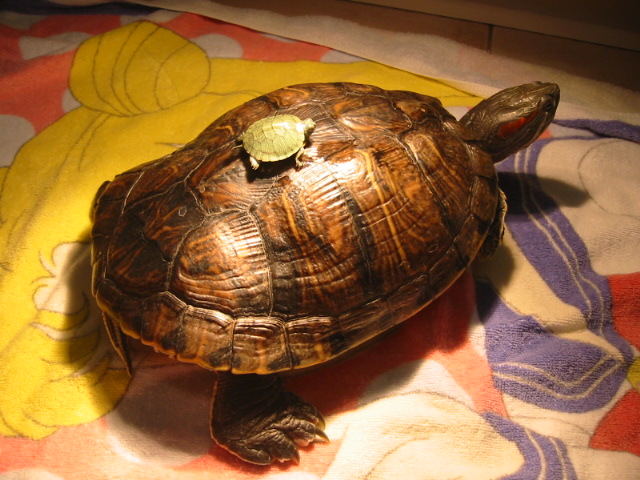
Pet Turtle Care : Food to Give Red Eared Slider Turtles

Pet Turtle Care

When it comes to feeding your red eared slider turtle you have to make sure that you are giving them the right amount of vegetation and animal protein. Make sure that you are feeding them a balance between the two so that they are getting the right amount of nutrients and vitamins.

As babies they need to eat large amount of animal protein because they have a very large carnivorous side to them. However, it is still a good thing to feed them a few vegetable materials.

Don't be surprised though if they don't eat much of the vegetation till they are older. When they become adults you can pull back on the animal materials and feed them mostly vegetation.

You can offer red eared slider pellet food. They have a bit a mixture of the right amount of vitamins and minerals. They are sometimes more convenient for pet owners. But this should not be the only thing that you feed them. It is great if you mix their food up a bit to keep them from getting bored and to make sure that they are getting all of the nutrients that they need to be healthy.

Food To Feed Red Eared Sliders

When it comes to feeding them you can give them earthworms, live feeder fish (this includes goldfish, guppies, minnows), waxworms, crickets, aquatic snails, daphnia, earthworms, silkworms, mealworms, and blood worms. These should only be given to small turtles. Adult red eared slider should eat larger animal items.

When feeding turtles vegetation stick with collard, kale, bok choy, mustard, dandelions greens, and dark green leaf lettuce. Never feed them iceberg lettuce because it does not have much nutrition.

If your turtle lives in a pond or aquarium you can always add aquatic plants to feed them. They love to snack on submerged plants like frog-bit, water hyacinth, water lettuce, azolla, anacharis, and duckweed.

Turtle Pet Care is a great site to teach people what it takes to take care of a pet turtle. You need to know how they should live, what kind to get, and of course how to make sure that they stay healthy.

Article Source: http://EzineArticles.com/?expert=Naomi_West

Pet Turtle Care : Looking After Aquatic Turtles

Pet Turtle Care

If you are interested in keeping a pet turtle in your home, there are a lot of different types to choose from, including those who can live in dry habitats and those that require wet habitats. Whichever kind of pet turtle you choose, you should know what caring for it involves and what it takes to look after turtles at home.

One of the first and most important things that you should consider when looking for a pet turtle is whether you want an aquatic turtle or a turtle that lives in a dry habitat. If you choose an aquatic turtle, also known as a water turtle, you need to be sure that you have the right kind of equipment in your home to properly provide for its care.

Aquatic turtles generally have shells that are softer and lighter in color than those of land based turtles. This helps them to stay in the water without sinking and to swim faster and with more agility than larger turtles or land based turtles. They have different colorings and markings on their shells, showing the kind of turtle they are and where they come from.

Semi-aquatic turtles make excellent pets to have in your home. You need to make sure, however, that you provide a suitable environment for them which includes both an area to swim around in and a basking ground with plenty of sunshine (or a UV lamp). The temperature of the environment needs to be carefully regulated. The water should be kept cooler than the rest of the habitat.

You should also keep in mind that aquatic turtles, like most other types of turtles kept as pets, do have a long life expectancy; some breeds live for many decades while some can even go up to a hundred years!

They are prone to various diseases so make sure to carefully note any changes in their behavior. Give special attention to the condition of their shell, as this is usually an indicator if something is wrong with your turtle. They need plenty of fresh vegetables to eat and a shallow bowl of fresh drinking water available to them at all times. Aquatic turtles can indeed make wonderful pets.

Do you need more information about caring for water turtles?please visit: Aquatic Turtles

Article Source: http://EzineArticles.com/?expert=Paul_Bryan

Pet Turtle Care : Top Tips on Choosing the Right Turtle Tanks

Pet Turtle Care

When you decide to keep a turtle as a pet, you have to invest in turtle tanks to put the turtles in. Turtles are low maintenance creatures and once they have settled down in their tanks, they really require nothing much except clean, fresh, bacteria-free water that is aerated.

In terms of maintenance, they are as demanding as fishes - meaning, they are not demanding at all. Give your turtle its freedom in the turtle tanks and it will be more than happy, paddling by itself and sometimes looking out for its owner or following simple commands.

Turtles are extremely hassle-free pets.

Necessity of turtle tanks

Even before you buy your favorite species of turtle, you need to decide on the tank as a turtle requires a proper natural habitat to survive.

A spacious roomy turtle tank with clean, fresh, bacteria-free, aerated water is necessary to prevent the development of skin and shell disease and ear abscess which are results of poor hygiene. It may even turn fatal. You should also never overcrowd the tank with more turtles than it can fit.

Set up a turtle tank outside the home, close to nature, in a corner of your yard where the turtle will feel happiest. Your yard should be a safe place, short of predators or environmental concerns.

Don't keep your turtle tank out in the yard if you spray pesticides on your plants. It will be harmful for your turtle.

Living outside in the open, in harmony with nature will ensure that a turtle knows when it's time to go into hibernation. A proper hibernation ensures a healthy liver. If you keep the turtle inside your home, it won't be able to determine the right time to hibernate and may fall prey to liver damage.

Size of turtle tanks

40-gallon turtle tanks should be the minimum size. You may want to go for a bigger tank (as needed), but it should certainly not be smaller than this as turtles require roomy habitats.

Features of turtle tanks

Must haves in a turtle tanks are:

• A dry land area

• A bit of marshy region

• Water area

Most turtles that are kept as pets are amphibians that paddle about in the water and love to bask in the sun on a dry piece of land. They should be able to submerge themselves completely in the water and at the same time stick their heads out of their shells comfortably. Water depth can't be more than 2 feet. Appetite-whetting plants should be planted in the marsh.

For tips on box turtle care and turtle breeding, visit the Turtle Facts website.

Article Source: http://EzineArticles.com/?expert=Peter_J_Lee